Guests no longer walk from restaurant to restaurant
Today the average pilgrim doesn't choose a restaurant by asking the receptionist at their hotel. They take out their phone and ask: "recommend the best restaurants in Međugorje with good value for money".
More and more often that question doesn't go to Google but to ChatGPT, Gemini or another AI tool. And those tools can't recommend what they can't read. For them, a restaurant without a website practically doesn't exist, however good it is.
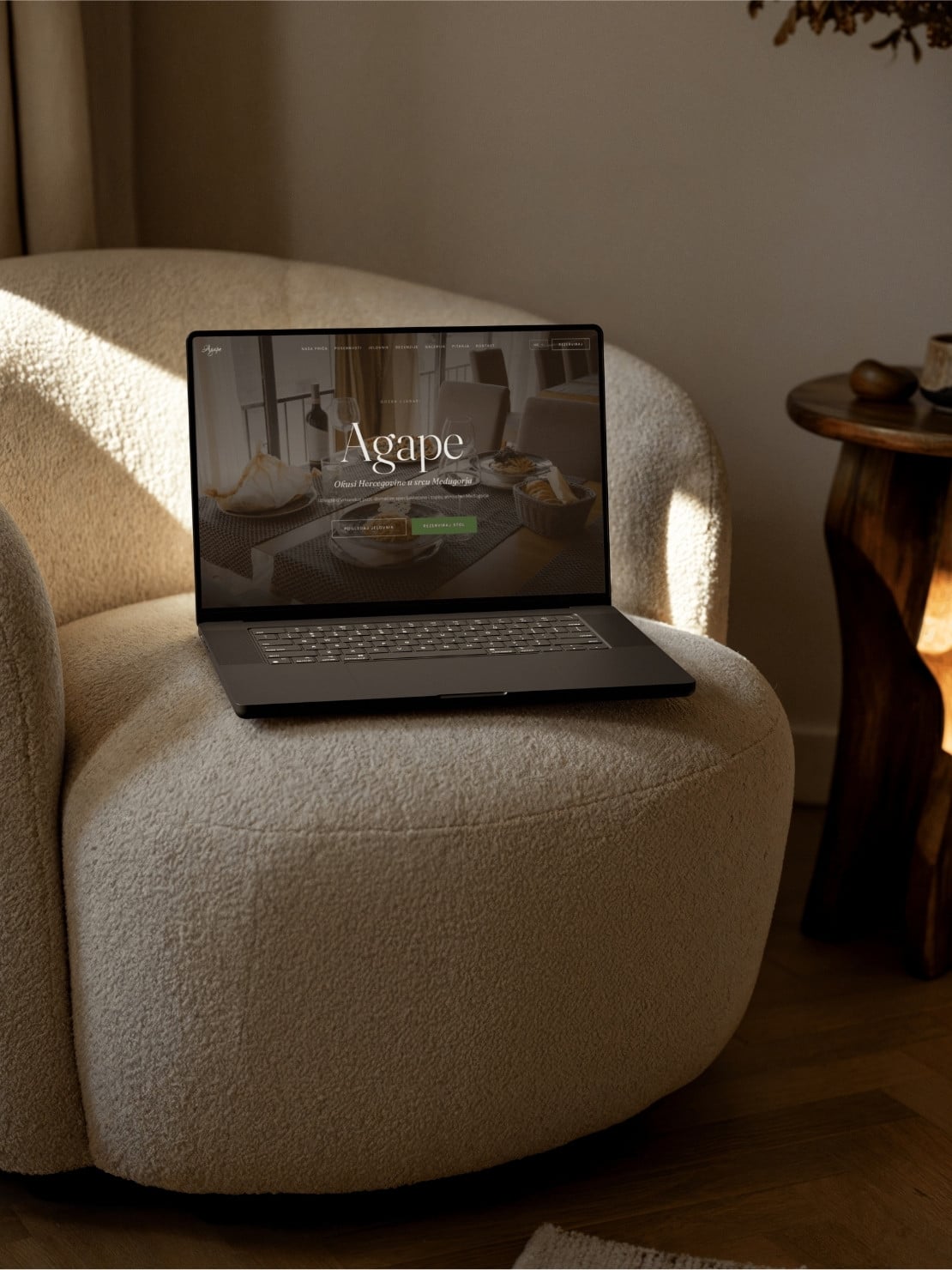
Agape had everything except that: a place on the internet a machine can read, understand and pass on.
What we did
The website was the backbone, but not the whole job. It was just as important to put everything around it in order, because AI tools and search engines don't look only at the website but at the picture of a place that forms across several sources.
Photography that carries the whole website
The camera came before the code. Together with the photo studio Ćuže we photographed the restaurant, the dishes, the ice cream and the people who work there.
This is the part most often skipped, and the one most visible. A guest choosing where to eat decides with their eyes before reading a single sentence. Those photos now carry both the website and the Google Maps profile, and in our estimate they are one of the biggest reasons the site works.
A digital menu in three languages
The most important part of the website isn't the homepage but the menu.
We made it simple, clear and organised by category, with prices guests can switch between convertible marks (KM) and euros. All of it in Croatian, English and Italian, because guests in Međugorje come from all over the world.
When someone at the table opens their phone to see what's on offer and what it costs, it has to work first time. No PDF you can't zoom into and no prices you have to convert in your head.
Reservations, questions and contact
Reservations take one tap to WhatsApp, because that's the channel guests are already on.
We also added frequently asked questions: opening hours, distance from the church, whether there are vegetarian dishes, whether you can pay by card, whether the space is accessible. Those questions do two things at once. They give guests an answer before they have to call, and they give search engines and AI tools exactly the kind of content they find easiest to quote.
At the bottom are the map, address, phone numbers and social media. None of it is decoration. All of it is information someone is looking for.
Google Maps profile
The website and the Maps profile have to say the same thing. The same address, the same opening hours, the same photos, the same name.
When that information differs, a search engine doesn't know which source to trust, and an AI tool prefers to recommend a place there's no doubt about. So we set up the Maps profile alongside the website, not as an afterthought.
Why agape-medjugorje.com and not agape.ba
This is a decision people rarely think about, and it carries a lot.
Agape isn't the only restaurant in the world with that name. A domain like agape.ba or restoran-agape.com says nothing about where the place is, so search engines and AI tools have to rely entirely on the content to work that out.
agape-medjugorje.com carries the answer in its name. The place name in the domain matches how people actually search: nobody types just "agape", they type "agape međugorje" or "restaurant međugorje". For an AI tool putting together a recommendation, that's one less step of doubt.
A domain is one of the few decisions that is expensive to change later. It's worth making at the start, and making it based on how people search, not on what sounds nice.
Results
This is where case studies usually put figures without a source. Here is ours, with a source and the exact period.
Google Search Console measures how many times links to a site were shown to a user within generative AI in Google Search. That's the AI summary that answers before you open a single result.
For Agape that figure is 924, in the period from 21 July to 9 September 2026, which means the first 50 days the website was live.
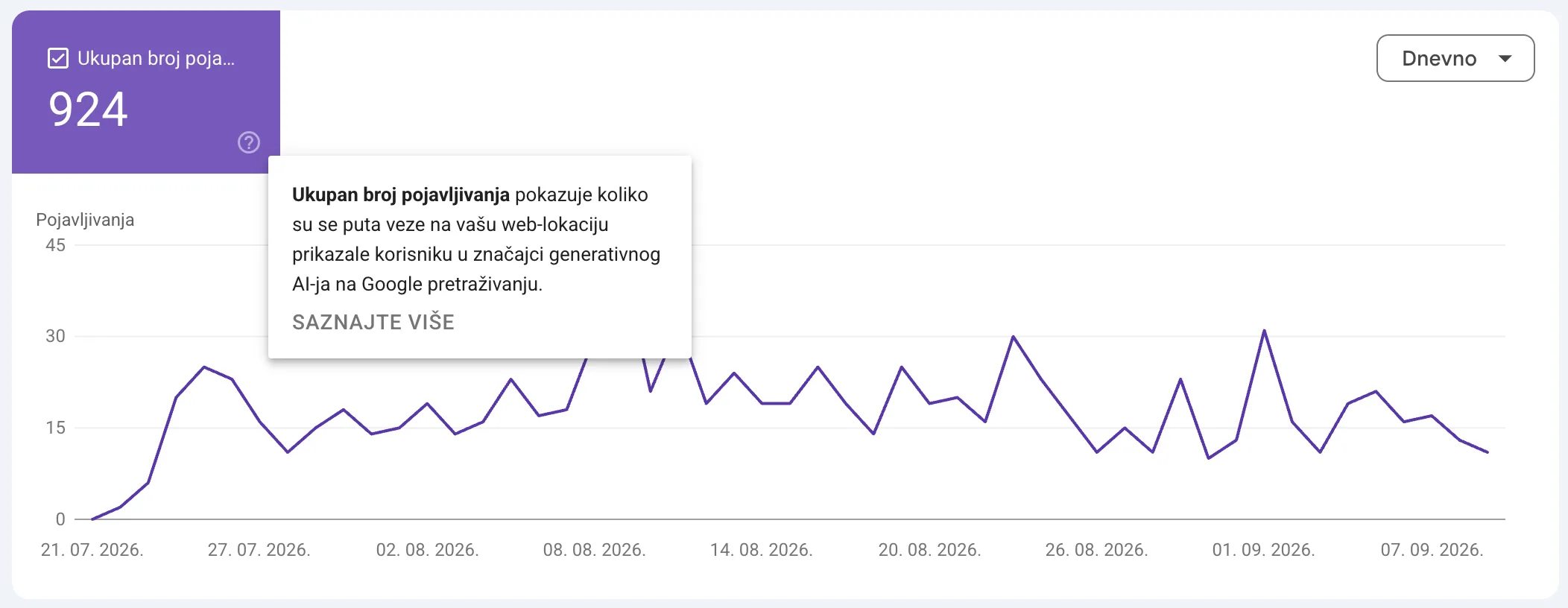
Two clarifications, because without them the figure doesn't mean what it seems to.
First, these are impressions, not clicks. Agape appeared 924 times in an answer Google put together for someone who asked something.
Second, this is only Google. ChatGPT, Perplexity and other tools have no public report for site owners, so we can't measure how many times they recommended Agape. We won't guess either.
A website that didn't exist 50 days earlier now appears in answers to questions in which nobody mentions its name.
Want the same for your brand?
Thank you to the Agape team for trusting Evola with this work.
If you want a website that is beautiful, functional and optimised for AI tools, get in touch through the contact form, by phone or on any of our social media channels.
Let us start your brand's evolution.